
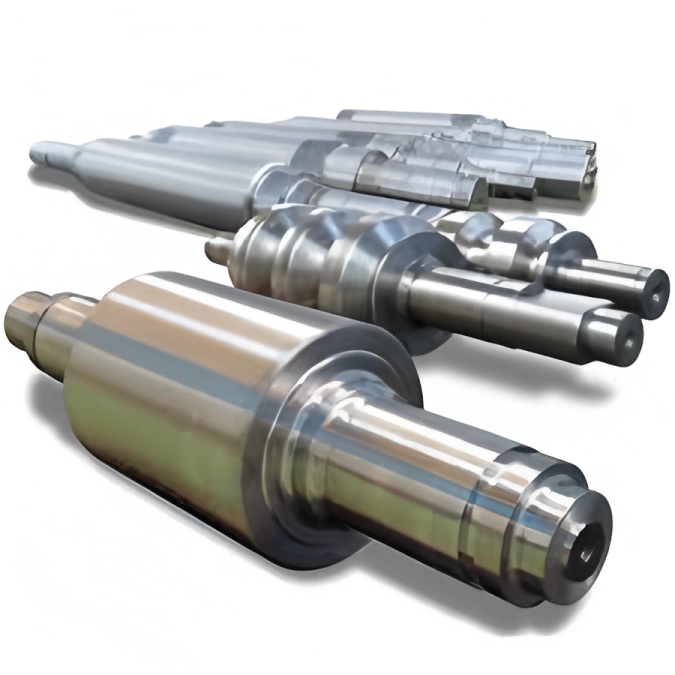
Introduction
Work rolls are critical components in rolling mills, directly contacting billets under high temperatures, speeds, and heavy loads in demanding operating conditions. After quenching and tempering heat treatment, small surface cracks were detected on a work roll. This analysis aims to identify the crack characteristics and their root causes through comprehensive inspection.
Technical Requirements
Material: X40CrMoV51
Manufacturing process: Ingot casting → Forging → Annealing → Rough machining → Quenching & tempering → Semi-finishing → Stress relief → Finishing
Technical specifications:
(1) Quenched and tempered surface hardness: 37-58 HRC
(2) UT testing per JB/T 5000.15-2007 Level II
(3) Steel ingot processed via electric arc furnace + refining + vacuum degassing
Chemical composition requirements shown in Table 1, with [H] ≤ 2.5ppm, [O] ≤ 40ppm, [N] ≤ 70ppm
Manufacturing Process
Forging using 4t steel ingot heated to 1200°C with 3-hour holding time
Initial upsetting followed by drawing and forming
Post-forging normalization to relieve residual stress and reduce hardness
Heat treatment curves shown in Figures 2-3
Testing and Analysis
Macro Examination
Two small axial surface cracks detected, maximum length 8mm with visible opening
Chemical Composition
Analysis from crack-adjacent samples (Table 2) shows compliance with specifications:
Trace elements: [H] ≤ 0.78 ppm, [O] ≤ 15.1 ppm, [N] ≤ 65 ppm
Sulfur Print Test
Result: Level 2.5, indicating significant sulfur segregation
Macrostructural Analysis
Results (Table 3) reveal:
Typical slag inclusion defects
Obvious dendritic segregation
General spot segregation level 2.5 (unqualified)
Coarse dendritic segregation at R/2 position
Incomplete breakdown of as-cast structure
Microstructural Analysis
Results (Table 4) indicate:
Acceptable purity levels but numerous TiN inclusions
Tempered troostite/troostite+bainite structure
Uneven microstructure distribution
Severe banded segregation
Insufficient normalizing before quenching and tempering
Fractography Analysis
Fracture surface exhibits fibrous structure with minor lamellar components
Blue fracture test rating: 1A/2A (qualified)
Failure Analysis
Chemical composition meets requirements
Macro-testing reveals unqualified spot segregation (Level 2.5) caused by:
Poor ingot crystallization conditions
Slow cooling rate during solidification
Gas and inclusion accumulation
Microstructure shows severe banded segregation from insufficient normalizing
Crack characteristics indicate:
No inclusion-related features
No oxidation/decarburization
Association with segregated bands
Likely forging cracks extended during quenching
Corrective Measures
Enhance steel purity and control titanium content during melting
Revise forging process to:
Implement double upsetting and drawing
Maintain total forging ratio ≥6
Ensure drawing ratio ≥4
Break down dendritic segregation
Extend normalizing holding time for complete transformation
Implement post-rough machining:
Flaw detection
Magnetic particle inspection
Crack removal via grinding
Conclusion
After process improvements:
Metallurgical testing meets specifications
UT testing complies with JB/T 5000.15-2007 Level II
100% qualification rate achieved
No crack formation observed
Standardized work roll production process established
Forging quality significantly improved