
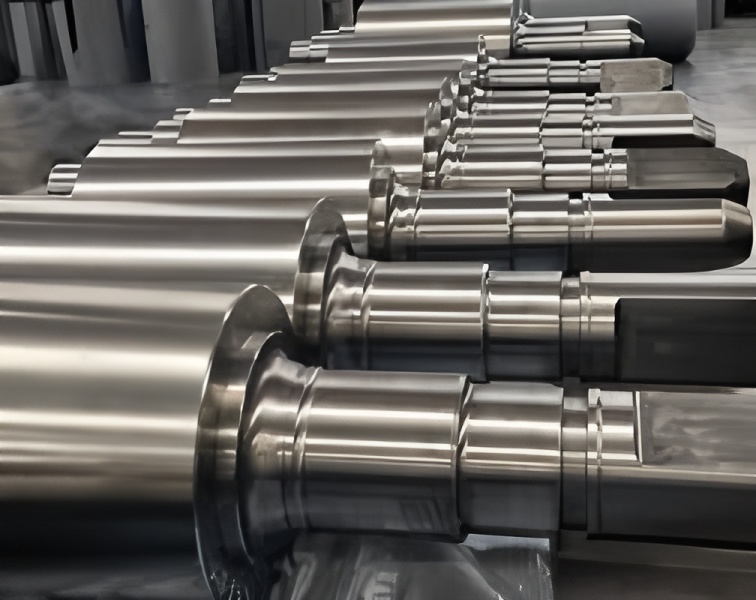
In the demanding world of metal forming and steel production, the quality of the final product is directly linked to the precision and durability of the equipment used. Central to this process are the rolling mill rolls, the critical components that shape and finish metal sheets, strips, and profiles. Among the various types, the forged steel roll stands out for its exceptional performance, strength, and longevity, making it an indispensable asset in modern rolling mills.
This article provides a comprehensive overview of what a forged steel roll is, its manufacturing process, key properties, and its vital applications, particularly in high-stress environments like cold rolling.
The Manufacturing Process: From Ingot to Precision Tool
A forged steel roll is not merely a piece of steel; it is a highly engineered component crafted through a meticulous multi-stage process. This process is designed to create a unique combination of a super-hard, wear-resistant working surface and a tough, resilient core and neck. HANI utilizes advanced techniques to achieve this superior quality.
- ➢Advanced Smelting: The journey begins with the selection of high-purity raw materials. Through advanced smelting and refining processes like Electric Arc Furnace (EAF) melting, Ladle Furnace (LF) refining, and Vacuum Degassing (VD), impurities are minimized. This ensures a clean, homogenous metallurgical base, which is crucial for preventing internal defects.
- ➢Forging: This is the defining step. The steel ingot is heated to a specific temperature and then subjected to immense pressure from hammers or presses. The forging process refines the internal grain structure, eliminates porosity, and aligns the grain flow. This results in a dense, tough material with significantly enhanced mechanical properties compared to a cast equivalent.
- ➢Heat Treatment: After forging and rough machining, the roll undergoes a sophisticated heat treatment cycle. This typically includes quenching and multiple tempering stages. This process precisely controls the final microstructure, creating a deep, uniformly hard working layer (for wear resistance) while ensuring the core and roll neck retain high strength and toughness (for accident resistance).
Forged vs. Cast Rolls: An Irreplaceable Advantage
While cast rolls have their place, the forging process gives forged steel rolls a distinct, irreplaceable advantage in specific applications, especially cold rolling and non-ferrous metal rolling. The primary difference lies in the material’s internal structure.
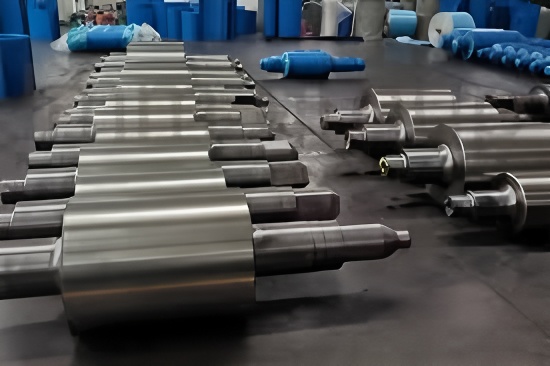
The image shows a Bainite ductile cast iron roll. While effective for certain applications, its cast structure differs significantly from the refined grain of a forged steel roll, which provides superior resistance to spalling and wear in high-pressure cold rolling.
The refined and homogenous grain structure of a forged roll provides superior resistance to common roll failures like spalling, cracking, and breakage. This makes them the preferred choice for the work roll in cold rolling mills, where immense pressure and pristine surface finish requirements are paramount.
Types and Applications of Forged Steel Rolls
Based on their intended use and operating conditions, forged steel rolls are broadly classified into two categories:
1. Forged Steel Hot Rolling Rolls
These rolls operate in high-temperature environments and are primarily used in the initial stages of rolling. Their main applications include roughing stands for hot strip mills, blanking mills, and profile steel roughing mills. The key requirements for hot mill rolls are excellent thermal shock resistance, good wear resistance at elevated temperatures, and high strength to withstand heavy reduction passes.
2. Forged Steel Cold Rolling Rolls
This is where forged steel rolls truly excel. Cold Mill Rolls are subjected to extreme pressures and demand flawless surface quality. The requirements are exceptionally stringent:
- High and Uniform Surface Hardness: To ensure the dimensional accuracy and mirror-like surface finish of the cold-rolled strip or plate.
- Deep Hardened Layer: Provides a long service life, allowing for multiple grinding cycles before the roll needs to be replaced.
- Superior Accident Resistance: The tough core and neck must withstand the immense rolling forces and occasional mill incidents without catastrophic failure.
- Pristine Metallurgical Quality: The material must be free from any internal inclusions or structural inconsistencies that could transfer to the strip surface or initiate a fatigue crack.
The evolution of materials for cold rolling mill rolls is a testament to the industry’s pursuit of perfection. The transition from traditional 2% Chromium (Cr2) steel rolls to advanced 5% Chromium (Cr5) alloys marks a significant leap in performance and durability.
Technical Specifications and Material Evolution
The performance of a forged steel work roll is defined by its material composition and the resulting physical properties. The development of high-chromium alloys has been pivotal in enhancing roll performance.
While Cr2 series cold rolls, with a working layer hardness above 90 HSD of about 10mm, have been the industry standard, the newly developed Cr5 series represents the future. With a working layer exceeding 30mm at a hardness above 90 HSD, Cr5 rolls offer vastly superior wear resistance, longer campaign life, and better overall performance. This comprehensive superiority is why Cr5 rolls are gradually replacing their Cr2 counterparts.
| Parameter | Forged Steel Roll (Cr2) | Forged Steel Roll (Cr3) | Forged Steel Roll (Cr5) |
|---|---|---|---|
| Material Grade | ~2% Cr Alloy Steel | ~3% Cr Alloy Steel | ~5% Cr Alloy Steel |
| Surface Hardness | 90 – 98 HSD | 92 – 100 HSD | 95 – 102 HSD |
| Hardened Layer Depth | ~10 – 15 mm | ~20 – 25 mm | > 30 mm |
| Core/Neck Toughness | Good | Very Good | Excellent |
| Primary Application | Cold Rolling Work Rolls (Standard), Temper Mills | Cold Rolling Work Rolls (High-Performance), Intermediate Rolls | Cold Rolling Work Rolls (Premium), High-Speed Tandem Mills |
Conclusion: The Foundation of Quality Rolling
In summary, the forged steel roll is a product of sophisticated metallurgy and precision engineering. Its superior properties—high wear resistance, exceptional toughness, and structural integrity—are achieved through a controlled process of smelting, forging, and heat treatment. These characteristics make it the undisputed choice for demanding applications, especially as a work roll for cold rolling mills where product quality cannot be compromised.
As a specialist in the field, HANI is dedicated to producing these advanced forged steel rolls. By leveraging cutting-edge technology and stringent quality assurance, we provide rolling mills with the reliable, high-performance tools they need to achieve optimal productivity and superior finished product quality.